

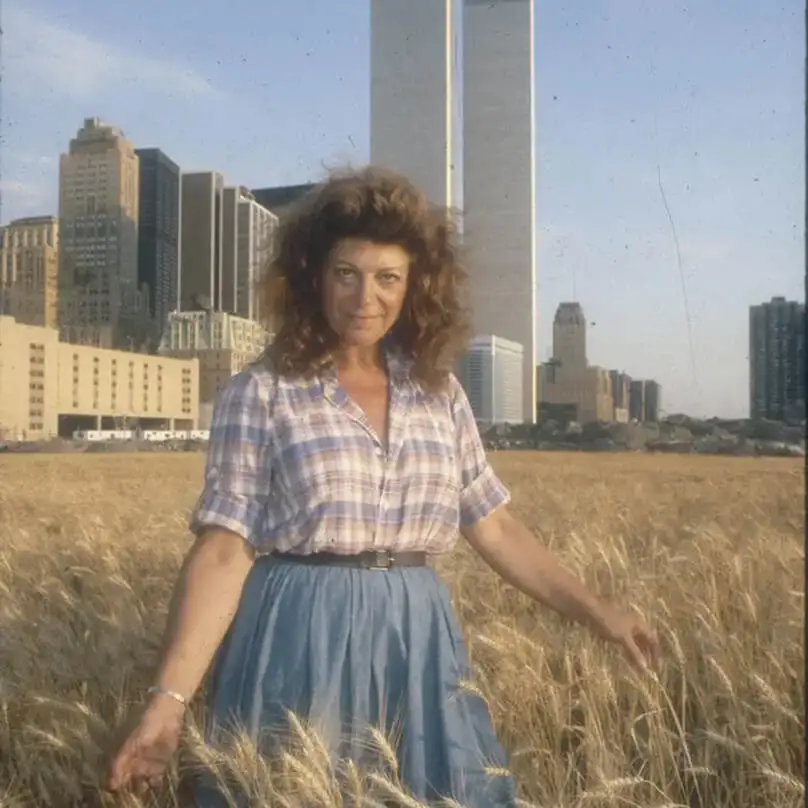
Agnes Denes, portrait, 1982
.svg)
.svg)
Agnes Denes, portrait, 1982
Agnes Denes, portrait, 1982
Agnes Denes, portrait, 1982
.svg)
Agnes Denes: Art in the Age of Ecological Reckoning
Born in Budapest in 1931 and having been based in New York since 1954, Agnes Denes is a visionary conceptual artist whose practice spans land art, poetry, writing, sculpture and drawing. A polymath and pioneer of ecological and land art, Denes often works on a monumental scale, drawing on frameworks of science, semiotics, epistemology, history, linguistics and psychology to question the relationship between humans and nature. Her work foregrounds the environmental and humanitarian challenges we collectively face, while conceptualising methodologies for navigating what lies ahead.
Pursuing what she calls a ‘visual philosophy’, Denes coined the concept of Eco-Logic, with ecology and logic serving as two foundational pillars of her concept-driven practice. The artist has dedicated her career to bridging the gap between the logical and the ecological, between the constructions of human thought and the uncontainable, often unexplainable forces of life. This paradox is at the centre of Denes’s work, its urgency taking shape across artistic mediums and forms, underpinned by the artist’s ground-breaking approach to meaning-making.
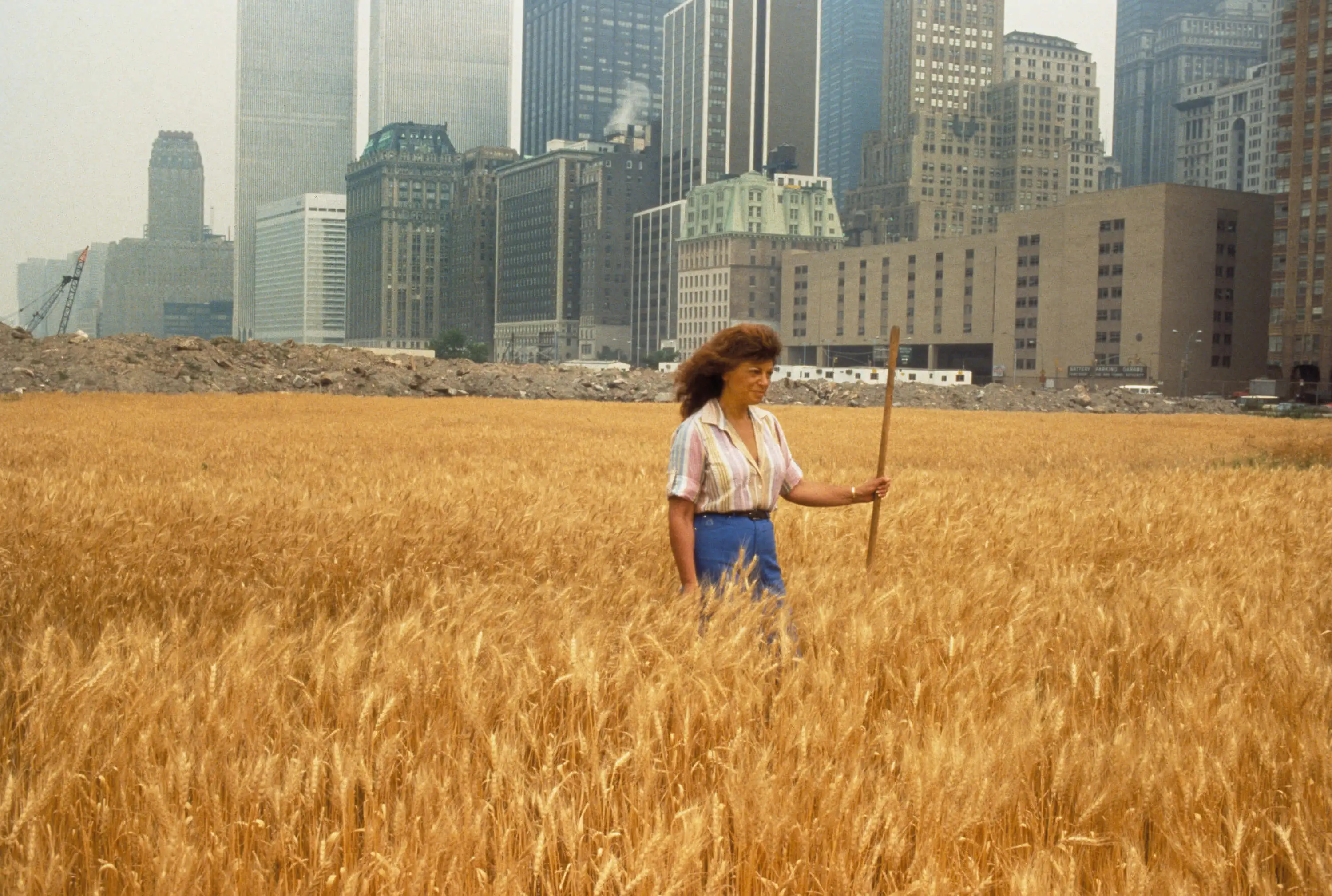
Wheatfield — A Confrontation: Battery Park Landfill, Downtown Manhattan — With Agnes Denes Standing in the Field, 1982
Photo: John McGrail, Courtesy of Agnes Denes
Wheatfield — A Confrontation: Battery Park Landfill, Downtown Manhattan — With Agnes Denes Standing in the Field, 1982
Photo: John McGrail, Courtesy of Agnes Denes
One of the first artists to incorporate environmental awareness into artistic practice, the work that brought Denes her international critical acclaim is Wheatfield — A Confrontation (1982). A 2.2-acre field of wheat was grown on the empty Battery Park landfill in Manhattan for four months in 1982. The golden field, with the skyscrapers of Wall Street in the background, was described by the artist as ‘a symbol, a universal concept’. A direct intervention in the metropolis, the work addressed the disparity between the urban and the rural realms, highlighting the issues of ecological neglect, the misuse of space, and the dissonance between real estate value and global environmental and social crises.
Through the visual metaphors that continuously reinvent the field of science, Denes’s work conjures a space for imagination that is beyond human perception, where the laws of nature are rendered in a continuous state of flux. To bend the rules in a world where, too often, human self-assurance has led to ecological collapse is to shine light on the need for new frameworks. To imagine the pull of gravity losing its force, or the continental drift taking a sudden new direction, is to conceive of possibilities for alternative modes of thinking about human presence within the natural world.
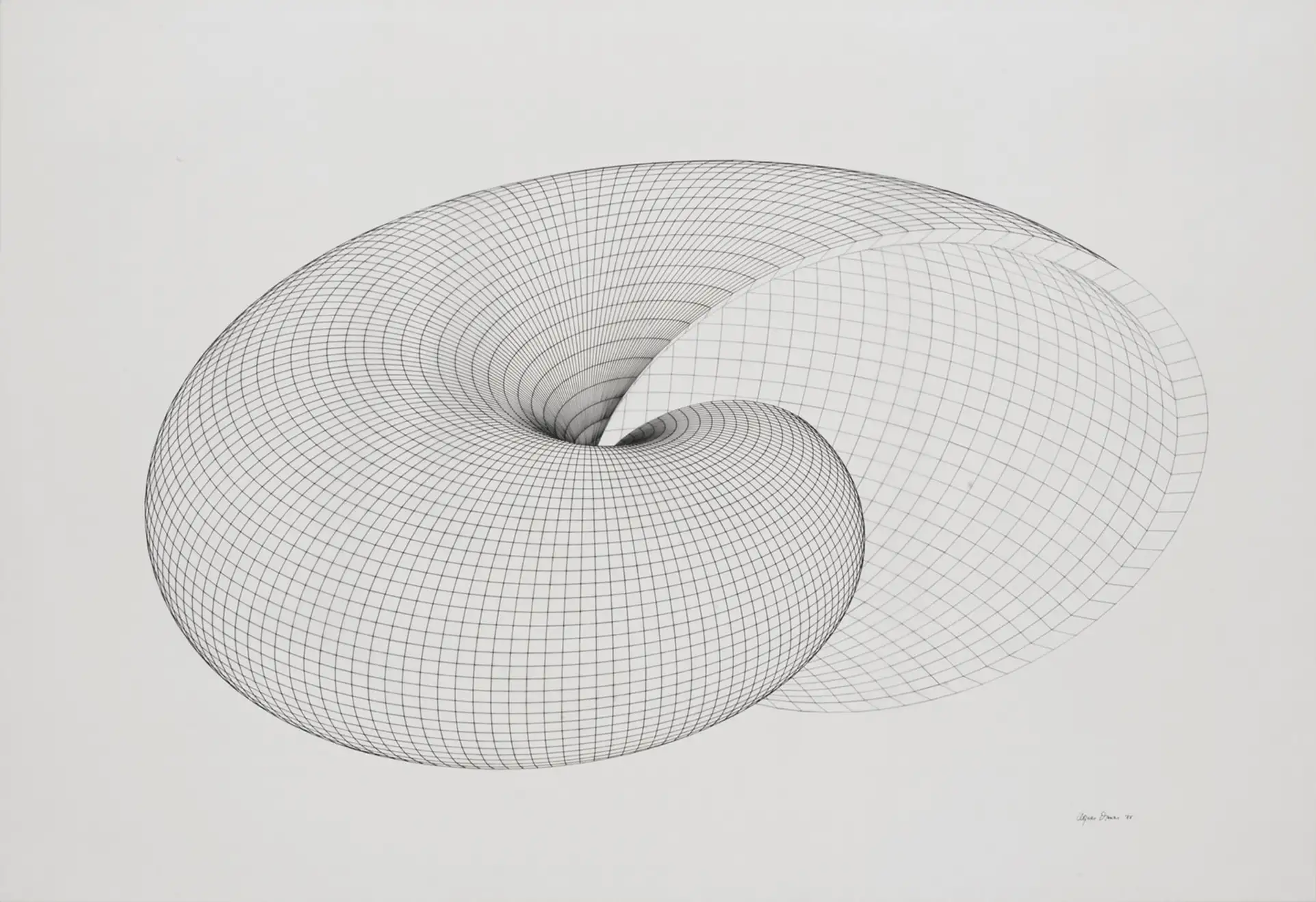
THE SNAIL, 1984 BY AGNES DENES
Lyra Collection
Copyright Agnes Denes, Courtesy Leslie Tonkonow Artworks + Projects
THE SNAIL, 1984 BY AGNES DENES
Lyra Collection
Copyright Agnes Denes, Courtesy Leslie Tonkonow Artworks + Projects
Denes’s innovative use of metallic ink to create drawings and prints, such as The Snail (1984), which LYRA is proud to hold in its collection, is emblematic of the artist’s explorations in mathematics, geography, and other scientific disciplines. The Snail addresses the visual paradox of nature juxtaposed with the limits of human understanding. Across her practice, the artist works with systems of communication, such as the patterns, codes, and symbols used to put abstract notions into a visual form. In her work, however, these systems are fused, uprooted and reimagined; the barriers between separate disciplines collapse. Here, Denes employs the methodology of isometric projection, a way of translating three-dimensional forms into a two-dimensional technical sketch. This approach reflects her fascination with the structures that shape knowledge, while exposing the slippages between perception and reality, reminding us that even our most rational systems remain acts of interpretation.
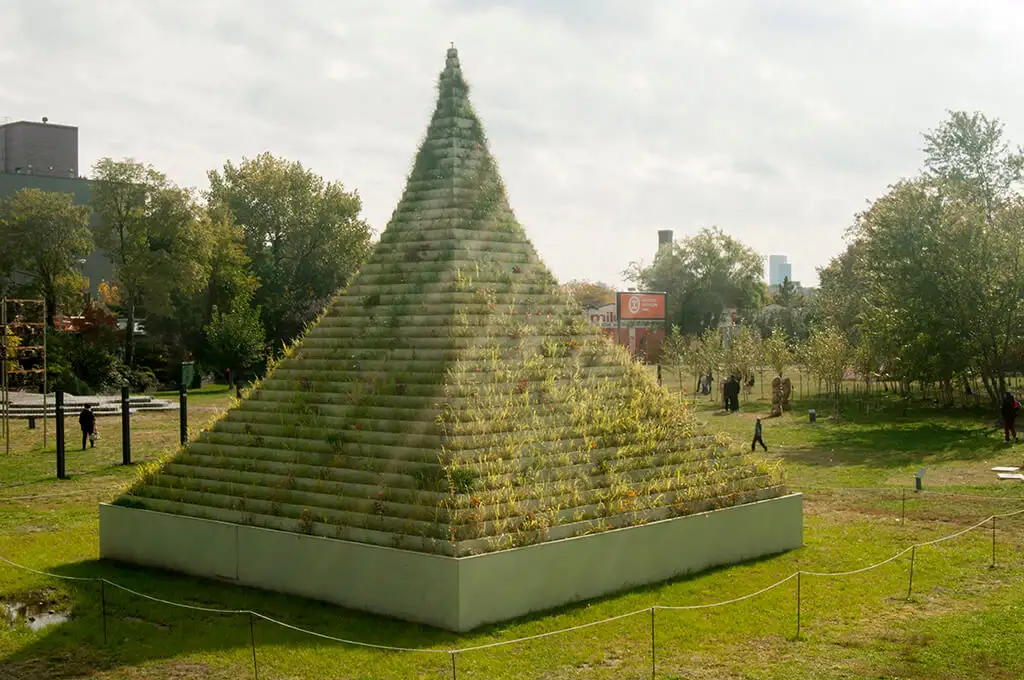
THE LIVING PYRAMID, 2025 BY AGNES DENES, AT DESERT X, SUNNYLANDS CENTER & GARDENS, RANCHO MIRAGE, CALIFORNIA
Courtesy of Desert X 2025
Photo: Lance Gerber
THE LIVING PYRAMID, 2025 BY AGNES DENES, AT DESERT X, SUNNYLANDS CENTER & GARDENS, RANCHO MIRAGE, CALIFORNIA
Courtesy of Desert X 2025
Photo: Lance Gerber
Throughout her career and across media, Denes returns to the pyramid as a form that encapsulates her philosophical enquiry into environmental conditions and social hierarchies. Breaking down the shape to its fundamentals and using complex mathematics, she pushes it into new forms that serve as tools for eco-social speculative analysis. Iterations of the artist’s investigation include pyramids constructed from fir trees, crystals, and piles of human dust, as well as plexiglas filled with oil and polluted water. The Living Pyramid – a piece shown at Socrates Sculpture Park, New York, in 2015; documenta 14 in 2017; Derest X, California, in 2025, among others – is one of Denes’s largest pyramid pieces, spanning 30 feet at its base and ascending 30 feet in height. The structure of stacked wooden terraces is filled with soil that is home to thousands of living plants and organisms. The pyramid is equally a fundamentally social structure, as it brings together the people responsible for its ongoing care.
At once introspective and public-facing, Denes’s work shapes new paths for visualising knowledge that is grounded both in the analysis of the present and in speculation towards the future. The artist often works with time capsules: questionnaires on the future of humanity filled out by the public, compiled during her exhibitions, and digitised in a time capsule to be opened in a thousand years. While the focus is on the speculative future, this artistic method equally encapsulates the zeitgeist of the now.
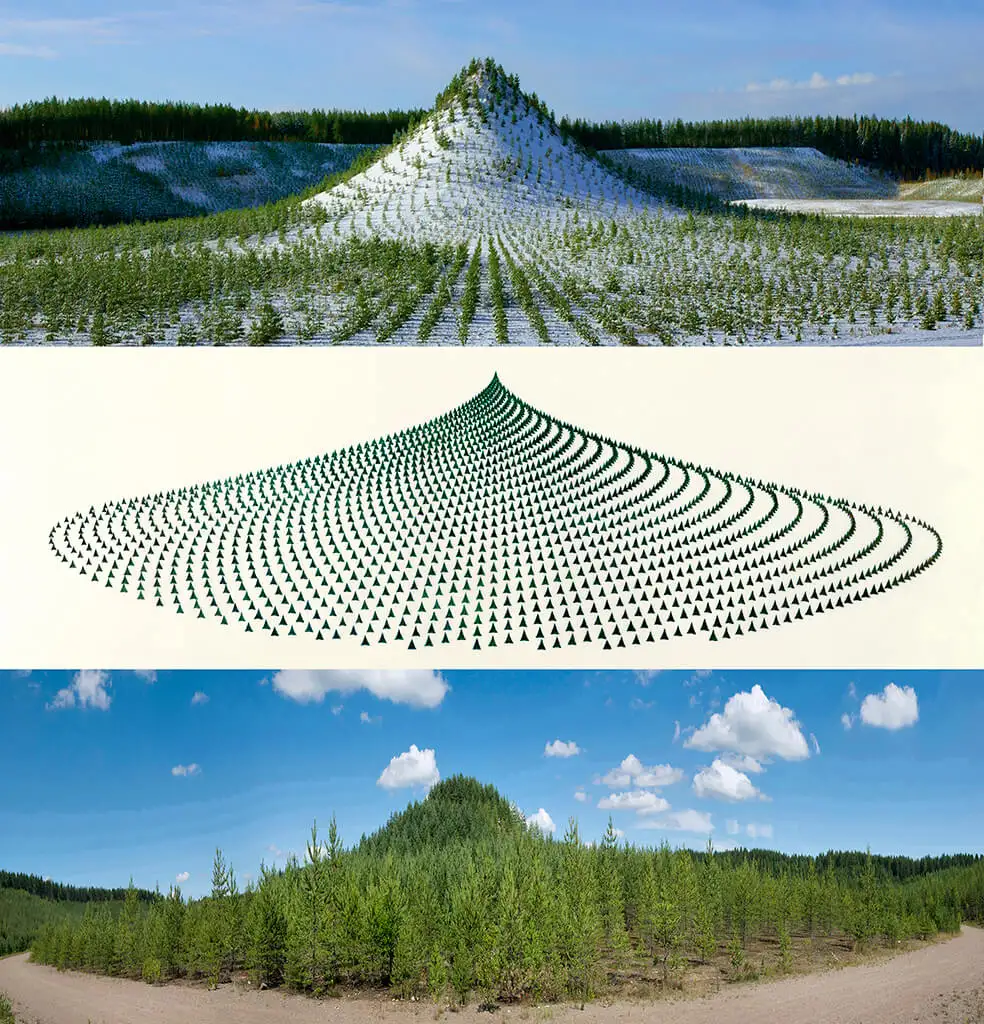
TREE MOUNTAIN—A LIVING TIME CAPSULE— 11,000 TREES, 11,000 PEOPLE, 400 YEARS, (1992–96/2013) BY AGNES DENES, IN YLÖJÄRVI, FINLAND
Copyright Agnes Denes, Courtesy Leslie Tonkonow Artworks + Projects
TREE MOUNTAIN—A LIVING TIME CAPSULE— 11,000 TREES, 11,000 PEOPLE, 400 YEARS, (1992–96/2013) BY AGNES DENES, IN YLÖJÄRVI, FINLAND


