

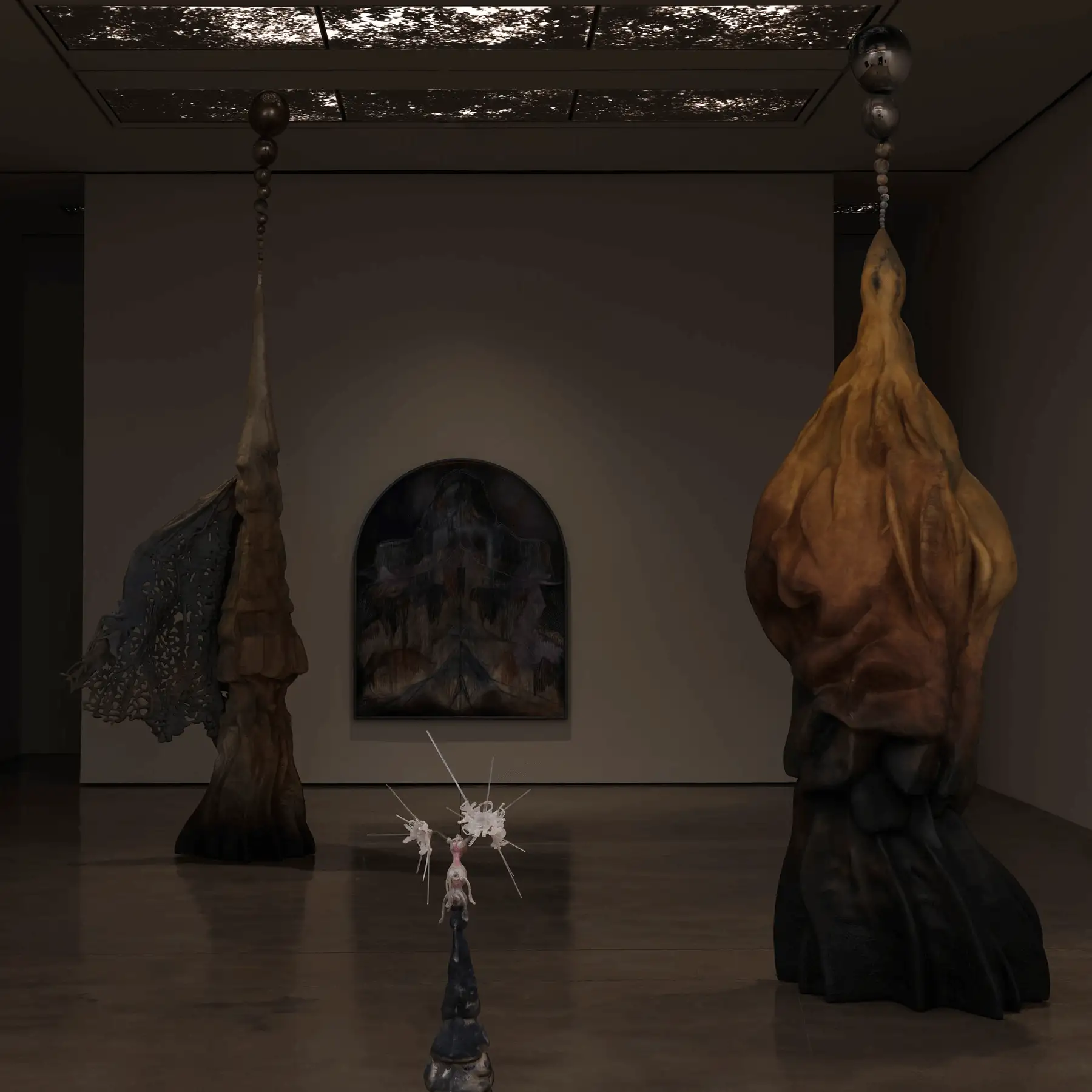
Marguerite Humeau, Migrations,
2022
59th Venice Biennale
.svg)
.svg)
Marguerite Humeau, Migrations,
2022
59th Venice Biennale
Marguerite Humeau, Migrations,
2022
59th Venice Biennale
Marguerite Humeau, Migrations,
2022
59th Venice Biennale
.svg)
Marguerite Humeau: Beyond the Limits of Knowledge
Moving fluidly between prehistory and imagined futures, Marguerite Humeau’s practice transcends temporal and spatial boundaries in pursuit of the fundamental mysteries of human existence. Renowned for immersive, large-scale installations that incorporate sculpture, sound and light, the French artist constructs speculative environments that invite audiences to step into parallel worlds shaped by both scientific inquiry and poetic imagination. Closely aligned with LYRA Foundation’s commitment to supporting artistic voices that challenge the norm, Humeau’s work draws on scientific research while deliberately pushing beyond the limits of established knowledge through imagination and speculation.
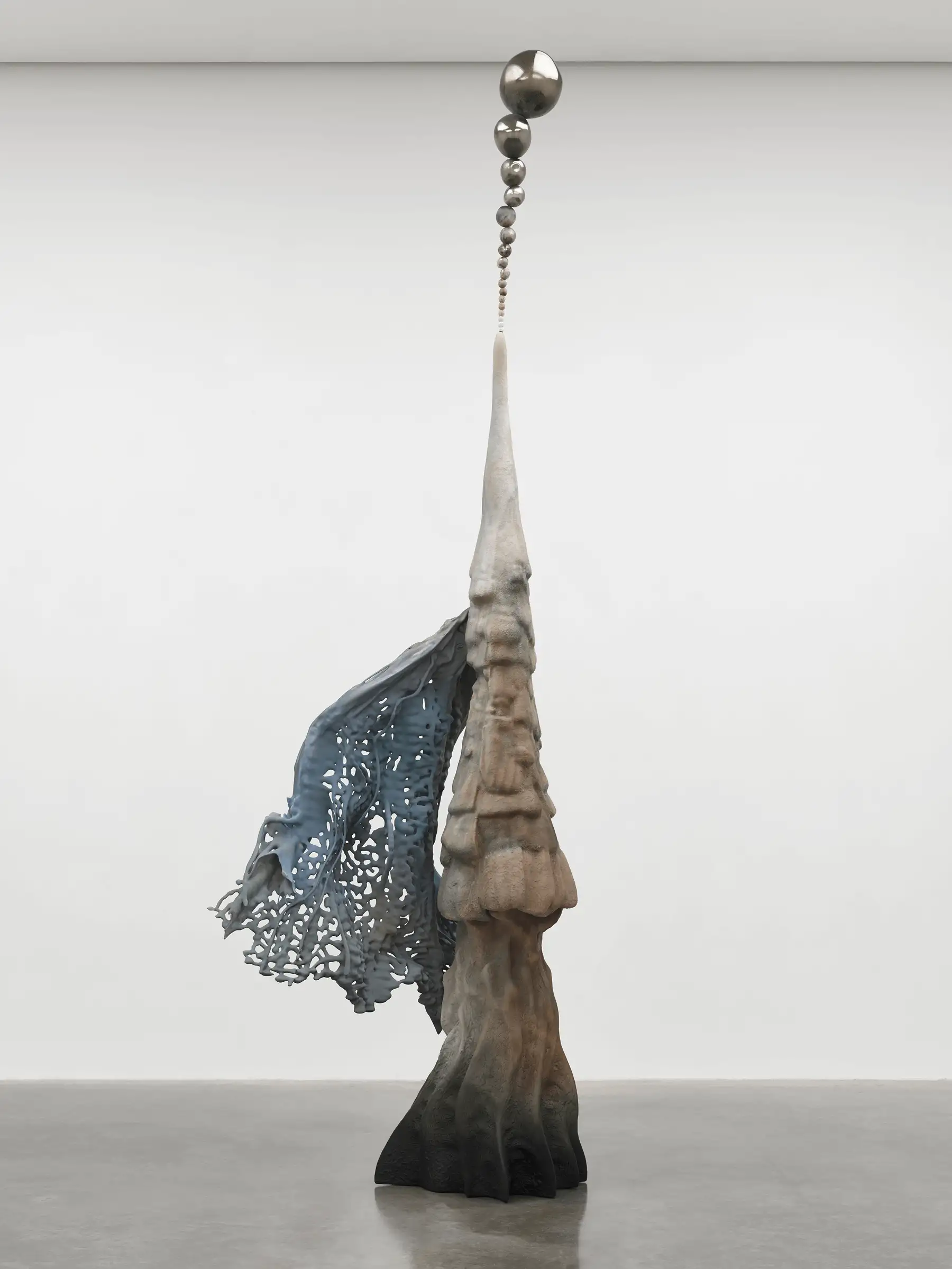
Marguerite Humeau, Stillenary (The Guardian of the Emergence): the paradox of creating movement through perfect...
2025
Courtesy, Lyra Collection
Marguerite Humeau, Stillenary (The Guardian of the Emergence): the paradox of creating movement through perfect...
2025
Courtesy, Lyra Collection
As her visual language collapses distinctions between past and future, Humeau revives lost lifeforms and forgotten ideas while simultaneously envisioning new species and yet-to-come forms of existence. Her research-led process is grounded in close collaboration with experts across fields including science, history, anthropology, palaeontology, zoology, biomedicine and linguistics, among others. More recently, she has turned towards historically marginalised or excluded forms of knowledge such as oral history, foraging practices and esotericism. While firmly centred in the real, her work continually stretches the boundaries of what is conventionally understood as fixed and normative knowledge.
Her installations possess an active presence, contextualising audience experiences that edge between the sublime and the unsettling. Conceived as immersive situations rather than isolated objects, they function as ecosystems composed of sculpture, sound and light, and a wide range of materials – ranging from 150-year-old walnut and hand-blown glass to alabaster, cyanobacteria, beeswax and wasp venom – in which individual works are interconnected, encouraging visceral and embodied forms of engagement.
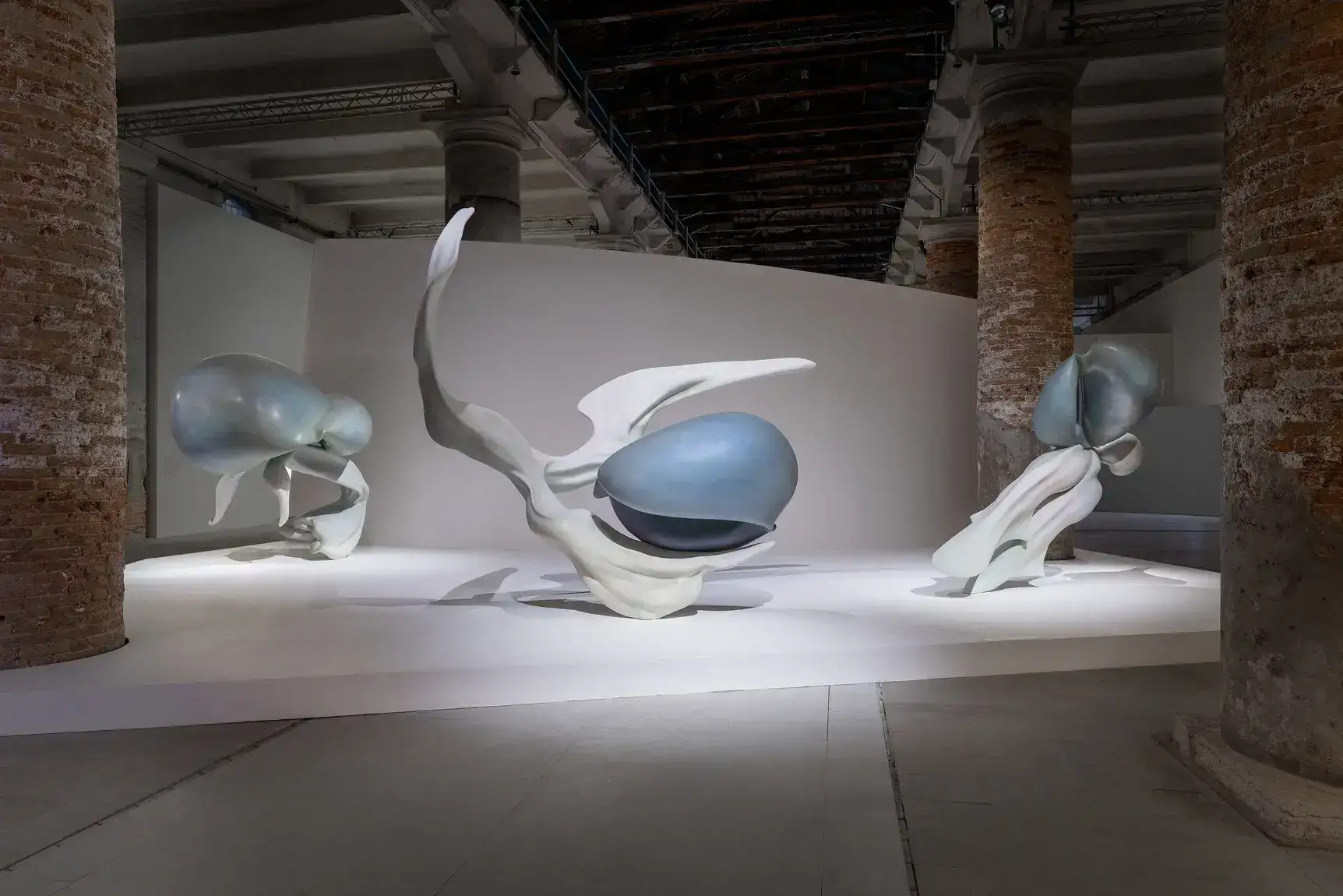
Marguerite Humeau, Migrations, 59th Venice Biennale
2022
Marguerite Humeau, Migrations, 59th Venice Biennale
2022
Her latest solo exhibition at White Cube draws on Humeau’s research into cave ecosystems, sparked by a visit to a cave in West Papua. Translating her experience of being submerged in water, in darkness, into the gallery’s flagship New York space, the artist frames the cave as a metaphor for transition and uncertainty. The cave becomes a site of encounter, where life forms evolving in darkness emerge as guides for reimagining connection beyond the visible. In this realm of the unknown and the undetermined, new forms of care and resilience emerge, shifting attention from the individual towards collectively imagined futures.
Within this environment, a colossal sculpture recalling the crystalline formations of stalagmites rises to nearly four metres in height. Titled Stillenary (The Guardian of the Emergence), the work takes its name from a neologism coined by the artist. This gesture reflects Humeau’s interest in John Koenig’s The Dictionary of Obscure Sorrows and its semantic experiment of naming emotive states otherwise inexpressible in the English language. The sculpture describes what Humeau calls “the paradox of creating movement through perfect stillness.”
Stillenary (The Guardian of the Emergence) is formed through a continuous process of layering, pigmenting and lacquering. As a result, its colour and surface appear perpetually in flux, as though still growing ever so slowly. “It is not really about creating sculptures,” Humeau notes, “it’s about creating life. These works have something that feels almost liquid. They’re alive, dead or somewhere in between, but they all have a soul.” The work, which LYRA is proud to hold in its collection, functions as a sentinel within the exhibition, guiding viewers through states of uncertainty and into the unknown.
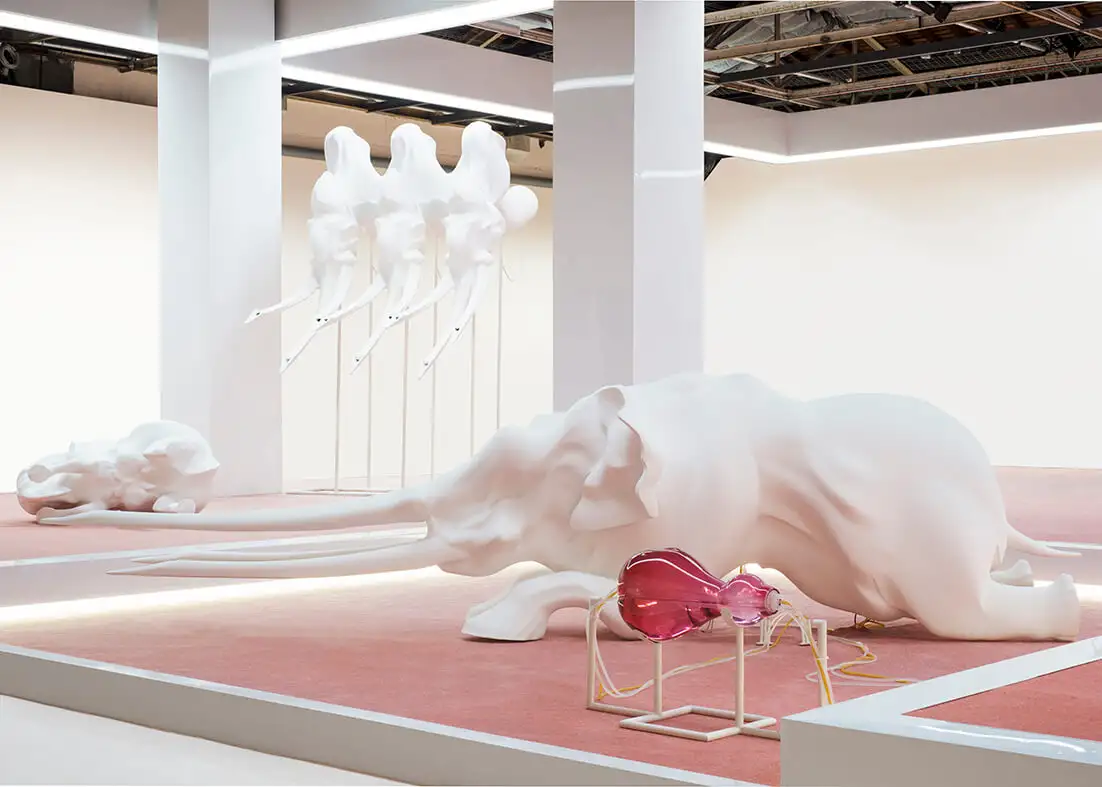
Marguerite Humeau, Echo, A matriarch engineered to die, 2016, installation view, Palais de Tokyo, Paris
Photo: Spassky Fischer
Courtesy the artist and CLEARING New
Marguerite Humeau, Echo, A matriarch engineered to die, 2016, installation view, Palais de Tokyo, Paris
Photo: Spassky Fischer
Courtesy the artist and CLEARING New
In her first major UK solo exhibition at Nottingham Contemporary in 2017, she constructed what she described as a “biological showroom”: a world in which modern humanity had become extinct, or perhaps never existed at all. Instead, the space was inhabited by prehistorically scaled elephants that had genetically mutated to have vocal cords (FOXP2), their forms developed in collaboration with scientists. Such speculative evolutionary timelines, grounded in the very real possibility of human extinction, continue in High Tide, an installation composed of futuristic marine mammals frozen in what resembles a ritualised dance. Exhibited in 2019 at the Centre Pompidou in Paris, the work drew parallels between climate change and non-human consciousness, opening space to imagine the profound and often detrimental consequences of human activity on other forms of life.
Themes of death and life recur throughout Humeau’s practice. She addresses the essential mystery of human existence and its contradictions by bending normative constraints of time and space. In Echoes (2017/18) at Tate Britain, London, she transformed the gallery into a hybrid space – part temple, part laboratory for the industrial production of an elixir of eternal life. Two semi-abstract white polystyrene sculptures referencing Ancient Egyptian deities occupied the space, surrounding walls coated in a toxic fluorescent yellow derived from the venom of the black mamba python. Accompanied by a sound work that attempted to reconstruct the voice of Cleopatra, the installation collapsed distinctions between past and future, along with those between myth, science and technology.

Marguerite Humeau, Echoes, 2018, Tate Britain, installation view
Photography by Joe Humphrys © Tate 2017
Marguerite Humeau, Echoes, 2018, Tate Britain, installation view
Photography by Joe Humphrys © Tate 2017
As organic matter merges with bioengineering and ancient histories intersect with a hypermodern world, distinctions between the known and unknown become increasingly unstable. In these transitional and uncertain spaces, where established narratives, hierarchies and timelines dissolve, Humeau opens up the possibility for alternative modes of being to take shape. Her work invites viewers to dwell in uncertainty instead of resolving it, proposing speculative worlds not as distant and fantastical futures, but as tools for rethinking coexistence, responsibility, and care in the present.


